Thursday, 15 November 2018


Pumping Iron for Justice: Conan, Masculinity and Ethical Muscles


Conan the Barbarian carries with him a certain level of cultural baggage. I think it is in part due to his birth in pulp-fiction that the muscle man is often shunned in academia and compared to grand narratives such as Tolkien’s Lord of the Rings trilogy to suggest the work’s inferiority (Weiss 2013: 79.) Stephen King wrote of Howard’s beloved sword and sorcery that it appealed to: ‘The fellow who is afraid of being rousted by those young punks who hang around his bus stop can go home at night and imagine himself wielding a sword, his potbelly miraculously gone.’ (King 2010: 204) I would argue however that King fails to notice to inherent nuance this sub-genre of fantasy proposes. If Conan is not an everyman hero, the idol of an emasculated or unmasculine man, what does Conan tell us about manhood and masculinity?

Conan’s affix tells us all we need to know about his classification by society. In The Tower of the Elephant, a ‘fat gross rogue from distant Koth’, a large foreign civilisation, is astonished by Conan: ‘he involuntarily drew back; for the man [Conan] was not one of any civilized race he knew] (Howard 2016: 58-59) The Kothian pulls back primarily because it is Conan’s body which is uncivilised. His supernaturally-masculine form - his ‘massive chest’ and ‘the hard, rangy lines of his powerful frame (Howard 2016: 59) - make him more animal than man. Conan’s body becomes ‘at odds with the environment in which it finds itself. It’s that body, that big, muscled form, that doesn’t match the civilized setting. Conan’s physicality ties him to the natural world even as it establishes a distance from the artificial world.’ (Elliott 2013: 62) Howard uses the imagery of nature to show the toxicity of civilised masculinity: Conan is ‘as much out of place in that den as a gray wolf among mangy rats of the gutter.’ (Howard 2016: 58) The civilised man as a mangy rat is unsurprisingly a critique of the potentially corruptive effects of society on masculinity. Moreover, it is this form of masculinity which can be labelled as ‘artificial.’ Conan is the product of nature, whereas the Kothian and the other men of the city are constructs of civilisation.

Conan’s wildness is explicitly designed to pit an uncorrupted natural man versus the corruptible product of civilisation. The city guards, arbiters of the law, have been paid off ‘with stained coins’ (Howard 2016: 57) so that the men in the district of thieves (the Maul) can do as they wish. In a society where justice – both literal and symbolic - sustains toxic masculinity it is no surprise that Conan, a paradigm of masculinity in its nature setting, is a heroic figure. For the emasculated or unmasculine man, the physical prowess of Conan becomes a vehicle for the implementation of justice and progress. Though the pseudo-science of physiognomy is long disregarded, there is still a cultural hangover which Elizabeth C. Evans labels as ‘physiognomic consciousness’ or the culturally mediated assumptions we make regarding physical appearance.[1] I would argue that the virtue of Conan’s body as discussed above is a form of this physiognomic consciousness. Muscle becomes symbolic of justice. He ‘looks the part’ as a heroic figure.

We can tell then that Conan is linked intrinsically to physiognomy; the virtue of muscle versus the sin of fat is made clear frequently. For example, we learn that the Kothian is a professional kidnapper who has come to Arenjun (the City of Thieves) to teach Zamorians how to ‘woman steal.’ Similarly, the Red Priest Nadonidus from Rogues in the House who is ‘the real ruler of the city’ is described as: ‘fat and full-fed, he was at once a fence for stolen articles and a spy on the police’ (Howard 2016: 130) I would argue that, as Daniel Weiss does, Howard wishes to show: ‘that other attributes -justice, fairness, honor – will be coded through the body at a visual level.’ (Weiss 2013: 81) When Conan confronts the pirates of the Red Brotherhood in Shadows in the Moonlight, Conan baits the pirate leader by sneering: “Send your dogs at me, big-belly...you were always a coward.’ (Howard 2016: 154) But just in case we were to have missed this description of his rotundness, Howard describes the pirate leader as a ‘naked giant’ with a ‘capacious belly.’ Conan himself takes part in the dialogue of physiognomy by making the link between fat and moral depravity clear to the reader. In the modern era, one might erroneously label Conan as a proponent of fat-shaming. However, I would argue that this physiognomic use of fat makes sense in the culture of the 1930s.

Muscle and fat were often indicators of class-based masculinity during the 1930s. For example: many artists, hired to paint murals under the Civil Works Administration in 1933, ‘celebrated the muscular potency of the working-class male body, which was contrasted (implicitly at least) with the flaccid, enervated, and emasculated bodies of both middle- and upper-class males.’ (Armengol 2014: 61) Conan’s place in the Hyborian “class” (station is more appropriate) system is made clear. The son of a blacksmith, Conan is born in the middle of a battle where both his mother and father die. By the age of 40, he makes himself the King of Aquilonia. To say he is a self-made man is an understatement. Yet, Conan doesn’t create anything. Unlike the working class of the 1930s, Conan makes his wealth via thievery and war. Conan doesn’t create empires, he takes them.

Conan is to some extent an anti-hero in that he provides a net-good despite his questionable behaviour. I would argue that the idea of a physically dominant working-class figure who fights injustices emanating from the physically inferior middle or upper-classes is a powerful one. Conan represents the growing sentiment in the 1930s that it was time to give up: ‘faith in the market-place as a proof of [their] manhood.’ (Armengol 2014: 60.) That is to say: money does not make the man. The evil characters of the Conan saga seem mostly to be monied men, and it is their lack of other masculine qualities which condemns them. Conan’s working-class masculinity, when pitted against the toxically masculine middle and upper-classes, shows that it is in fact these muscularly ethical men who should represent “man” (both gendered and of humankind).  The question then becomes, what makes a man masculine?  

In an era where classical ideas of masculinity: being the breadwinner, supporting the family and so on were being deconstructed by the devastating effects of a severe depression (unemployment was at 25% in the months around Conan’s first appearance) many men turned to their physical attributes to display masculinity. Harvey Green, author of Fit for America argued in an interview (Black 2009) that: ‘When the Depression struck, a characteristic response in America was to blame ourselves, Atlas interpreted the desire to transform ourselves as a way of self-improvement.’ In 1927, Charles Atlas opened his first gymnasium, and bodybuilding became one of the most successful businesses in America– especially during the Great Depression which would begin in 1930 (Kimmel 1996: 152-153). The idea of improvement via muscle is one which rings true with Howard. During his childhood, Howard told his father after a bout of poor health: ‘‘When I was in school, I had to take a lot because I was alone and no one to take my part, so I intend to build my body until when anyone crosses me up, I can with my bare hands tear him to pieces, double him up, and break his back with my hands alone.’ (Jones 2016: 590) I would argue that for Howard muscle becomes a source of agency.

Muscle represents the result of effort: heroism and masculinity, like muscle, are the products of hard work. Muscle allows Conan not only to survive in a world of villainous characters, but to thrive and push for justice. Conan represents a self-transformation from oppressed to dominator. Moreover, Conan is the transformative figure which society craved during the “Atlas” era of fitness. Conan holds an unshakeable ethical framework which ultimately is brutal yet just, while inhabiting a contemporarily ideal body. Howard leaves little room for guesswork as to what Conan represents: “the perfect man”.

Clearly, the body is an important aspect of Howard’s concept of masculinity. The idea of the body being the hallmark for masculinity certainly has some historical credibility. This fact sheds light on Howard’s depiction of masculinity in Conan the Barbarian, first published in 1932. It may also come as no surprise that Howard was an avid body builder and was supposedly a man of ‘formidable strength’ who boxed for some time in the heavyweight division (Finn 2006: 157) While this dulls the blade of Stephen King’s theory, it also explains some of the stories in Conan’s saga. As Winter Elliot points out: ‘in many ways, Conan’s physicality is more interesting than the sword he carries.’ (Elliot 2013: 65) In A Witch Shall Be Born, Conan catches a vulture with his teeth while nailed to a cross, a feat which is followed by the removal of the spikes which held him there (the removal of course completed by Conan himself), and a 10 mile walk in the desert without water. ‘If he’s fit to live in the desert’ as one of the men who “rescued” him says ‘he’ll live that long without a drink.’ (Howard 2016: 247) Conan’s raw constitution is his strength, and ultimately it is this powerful bodily version of masculinity which defines him. Conan's physical prowess beyond the sword is what marks him out from other men, and in the context of a body building culture, Conan is an ideal hero. He is powerful without the help of the man-made, he is self-sufficient and natural.

Based on this understanding of masculinity, one can only argue that Conan deserves his victories. On top of Conan’s financial and political conquests, the Conan sagas deal quite intimately with his sexual conquests. It would be fair to say that Conan is hardly egalitarian in its depiction of women. Women are often reduced primarily to their sexuality and body: Bêlit, a female protagonist and pirate, is dressed only in an unpractical ‘broad silken girdle’ (Howard 2016: 165) and after knowing Conan for the best part of five minutes exclaims: ‘take me and crush me with your fierce love (Howard 2016: 166). However, attempts to display Conan’s five-foot sword as a phallic display of insecure masculinity often miss the mark. What most commentators fail to notice is that like the women who are often left naked, so is Conan. In fact, the level of clothing a character wears often coincides with their link to the corrupt society of Hyboria. Conan, after killing the Kothian rogue, ‘walked through the night naked except for a loin cloth and his high strapped sandals.’ (Howard 2016: 61) It is in making him vulnerable that we see his masculinity, a man who does not require societies permission to succeed. This is reflected in both his sexuality, and sexual attractiveness.

Sexuality is nuanced in this world, and in many ways, Conan lives outside of the cultural practises of Hyborian masculinity. For example, we know that unlike most men in Hyboria, the eponymous hero is anything but rapacious: in The Vale of Lost Women we learn Conan ‘never forced a woman against her consent. Customs differ in various countries, but if a man is strong enough, he can enforce a few of his native customs anywhere.’ (Howard 2016: 559) While women are certainly objectified in the world, Conan is not the one objectifying them. Indeed, his “otherness” is an objectification held in common with women in the saga. In this scenario, these people are objectified and made other by a society which fears change and the upcoming agency of the progressive, physically impressive people of a lower station or class.

Conan’s masculinity works best in the fantastic due to its hyperbolic representation of muscle. Yet, ultimately, it is this hyperbole which highlights the points raised in the saga. Muscle represents not only positive change but becomes a physiognomic representation of an ethical man. He does not need to create, instead he exists to change and positively transform society. Conan becomes the fantastic version of the American man in the 1930s, a hero for the oppressed because he represents a viable transformation. You don’t need money to be a man and if one puts enough effort into transforming themselves, they can change the world. This is what Conan teaches us about masculinity.


Bibliography
Armengol, Josep M. “Gendering the Great Depression: Rethinking the Male Body in 1930s American Culture and Literature.” Journal of Gender Studies, vol. 23, no. 1, Feb. 2013, pp. 59–68
Elliot, Winter. “Life, Liberty and the Pursuit of Women: Gender Dynamics in the Hyborian World” Conan Meets the Academy: Multidisciplinary Essays on the Enduring Barbarian, edited by Jonas Prida. McFarland & Company, Inc., Publishers, 2013. pp. 60-78
Evans, Elizabeth C., Physiognomics in the Ancient World, Transactions of the American Philosophical Society 59, pt. 5 (Philadelphia: American Philosophical Society, 1969), 6
Finn, Mark. Blood and Thunder: The Life and Art of Robert E. Howard. Monkeybrain, 2006.
Howard, Robert E. The Complete Chronicles of Conan: Centenary Edition. Edited by Stephen Jones, Gateway, 2016.
Jonathan Black. “Charles Atlas: Muscle Man.” Smithsonian.com, Smithsonian Institution, 1 Aug. 2009, www.smithsonianmag.com/history/charles-atlas-muscle-man-34626921/
Jones, Stephen. “Afterword: Robert E. Howard and Conan” The Complete Chronicles of Conan: Centenary Edition, edited by Stephen Jones, Gateway, 2016. pp. 590-609
Kimmel, Michael S. Manhood in America: a Cultural History. Oxford University Press, 2012.
King, Stephen. Danse Macabre. Gallery, 2010.
Prida, Jonas, editor. Conan Meets the Academy: Multidisciplinary Essays on the Enduring Barbarian. McFarland & Company, Inc., Publishers, 2013.
Weiss, Daniel. “Robert E. Howard’s Barbarian and the Western: A Study of Conan Through the West and the Western Hero” Conan Meets the Academy: Multidisciplinary Essays on the Enduring Barbarian, edited by Jonas Prida. McFarland & Company, Inc., Publishers, 2013. pp. 79-99


[1] See: Evans, Elizabeth C., Physiognomics in the Ancient World, Transactions of the American Philosophical Society 59, pt. 5 (Philadelphia: American Philosophical Society, 1969), 6

Tuesday, 10 May 2016

Why Modern Art is All A Bit Wank or Modern Art as a Reflection of Pseudo-Intellectualism and the Rising Acceptance of Mediocrity.

When all is said and done, does anyone actually think that it's good?


You've probably just read the title of this article and thought one of two things. The first is "YES! Something I can get behind!" to which I say, well done you. The second thought is "ignorant bastard" to which I say, almost certainly (but not as ignorant as you.) I would like to think that, after reading my motion, the latter group might change their opinion.

I think that my argument boils down to two fundamental concepts. The first is that most people who talk about the 'intricacies' and 'genius' of modern art have fabricated those notions in the manner of an extremely rambunctious sophist. Anyone who holds the same position as myself is likely to have come across the argument 'you just don't understand' or some variation of this most original and insightful comment. More articulate critics and art scholars (not some washed up twenty-something, gap-year espousing Shoreditch vegan) would point you to Aesthetic Relativism. Aesthetic Relativism is, in many ways, the pre-cursor to the Body-Positive movement and our culture's quasi-erotic desire for mediocrity. By this I mean that, whilst it may make you feel happy that someone out there likes you or your work, it does not necessarily mean that you or your work is good and/or important. Moreover, most of the people who do like your work are probably as talentless or as lost as yourself, if not more so (a position I implore you to hold in relation to my work if you're not convinced.) .

Forgetting the flippantry, Aesthetic Relativism is, in short, the notion that beauty is in the eye of beholder. The classical artistic notion of objectivism in relation to the Methods of the Masters (demanding the highest level of excellence, improving on the work of previous masters and aspiration to the highest attainable quality) has been, for the most part, drowned in a Pollockesque puddle of pseudo-intellectualism based on the basic principles of Aesthetic Relativism. I think it's for this reason that modern art loses itself on the majority of people, let alone objective thinkers. In the words of the satirist P.J. O'Rourke "Like most sensible people, you probably lost interest in modern art about the time that Julian Schnabel was painting broken pieces of the crockery that his wife had thrown at him for painting broken pieces of crockery instead of painting the bathroom of the hall." O'Rourke has a point: pre-cursors to modern art such as van Gogh or Dalí are loved and celebrated for their artistic talent and innovation, not their life stories.


van Gogh's 'Starry Night over the Rhone'

Even a brief viewing of these works shows intense artistic skill and originality. The bold and blatant strokes of van Gogh fragment a relatively simple view of the Rhone; the surreal and intricate reflection of strong vertical lines of light against the overtone of horizontal sky and river really defines this image, there is visible artistic skill and sophistication here, mimesis is comprehensible. The time and effort is palpable, the strokes of paint at once seemingless and painstaking, creating a complex yet aesthetically pleasing piece. There is discipline in design and execution, in the same way that an orator designs and executes excellent rhetoric.

Dalí's 'The Disintegration of the Persistence of Memory'

Dalís work shows an even greater understanding of proportion, a divergent concept of form and composition on canvas, yet the ultimately fascinating and complex scene presented to us still leaves us asking questions. In many ways, the human condition is reflected excellently in this painting; a deconstruction of an earlier painting 'The Persistence of Memory', the themes of uncertainty, distortion, existentialism and aestheticism are all highlighted in the excellently crafted melting clocks, or even the commendable re-creation of an earlier piece's elements. 

Now, let's make one thing clear. Both of these artists would be considered Aesthetic Relativists. Both distort the classical concept of a 'pureness' or the attempt at 'perfect' replication. But this is, ultimately, ivory tower intellectualism. These works are excellent because, despite their surrealism, they are veritably gorgeous paintings. A viewer can note and explain artistic credibility with extraordinary prowess being shown in both. Where then, is the division between these artistic greats and the art we see today?

The problem is, modern art has latched onto modern culture. We're too afraid to be critical in case we hurt someone's feelings. We live in a world where criticising the Chinese government's systematic oppression of political prisoners can be construed as 'insensitive' because of cultural differences, despite artists such as Ai Weiwei portraying cries of desperation in their work. 'Fashion experts' applaud anorexic, abused girls in bin bags whilst the rest of the world watches on with confusion and horror. Modern culture is built for modern people, modern people of course being their own class of pseudo-intellectual 'not-quite-smart-enough' twenty-somethings who think that genius is asking questions and making statements. Children ask questions, animals are inquisitive. Questions aren't inherently intellectual, and certainly not novel. Anyone can make a statement, but your statement is only meaningful if it contributes to society or challenges intellectual thought. For some reason we have, in recent times, removed art from art. Art is now thought, and paintings just a coalescence of crusty oils hanging on the walls of ancient and respected institutions. What happened to the application of intellectualism to skill and expertise with the latter being the foundation of all good art?

This is not to say that asking questions or making statements are frivolous, but they are if you attempt to remove them from skill and suggest that they are art. This is, quite simply, a ridiculous concept; the marketplace for verbal or written artwork is in the literary world in novels, poetry or even in music. Art as a concept obviously covers all forms of artistic forms, but when specifically speaking of 'works of art' it does a genuine disservice to gifted artists when it is suggested that the GCSE standard prose of an art graduate can be compared to David, Picasso or Rembrandt.  

Ultimately, modern art's desperate attempt to reflect the human condition has led to the creation of an alchemical, Shellian house of mirrors: the audience and the artist spend a vast amount of time seeing bizarre machinations of their person before admitting to themselves that they are lost, promptly asking the steward to lead them back into the real world. Unlike Dalí or van Gogh, the importance of artistic credibility is sidelined in place of thought and opinion with the credo being that all opinions are valid. In the context of a debate or essay, this is only true if you can substantiate your claims. In my opinion, and that of many others, this is applicable in a similar way to the artistic credibility of an artist. The art historian Jakob Rosenberg phrases it best when he says that the quality of art "is not merely a matter of personal opinion but to a high degree...objectively traceable." You are not necessarily a chef if you have an opinion on the treatment of ducks in foie gras production, in the same way that you're not an necessarily an expert on the Middle East if you called someone Islamophobic once. This is to say, purely because you have an opinion on something, you are not necessarily an expert or an artist (a claim which I would not dare to make about myself in relation to artistic talent, I very much have a case of Doctor's Handwriting.)

Now, if you're a naysayer and think I still haven't proven why modern art is bad, I think now is the time to put the case to bed. Many people, even those who do think modern art is a bit naff, very much believe that 'art is opinion' or openly flirt with the question 'what is art?' These concepts have ultimately challenged the concept of what objectively good art is, for better or for worse. Naturally, I believe it has been done so for the worse. Why? Well, a brief comparison of two pieces of art; one a piece made under the philosophy of Universal Standards (see Methods of the Masters) and another under the philosophy of Artistic Relativism (by which of course I refer to the modern art I am challenging, not early relativists who still pursued an excellence of craft.) 


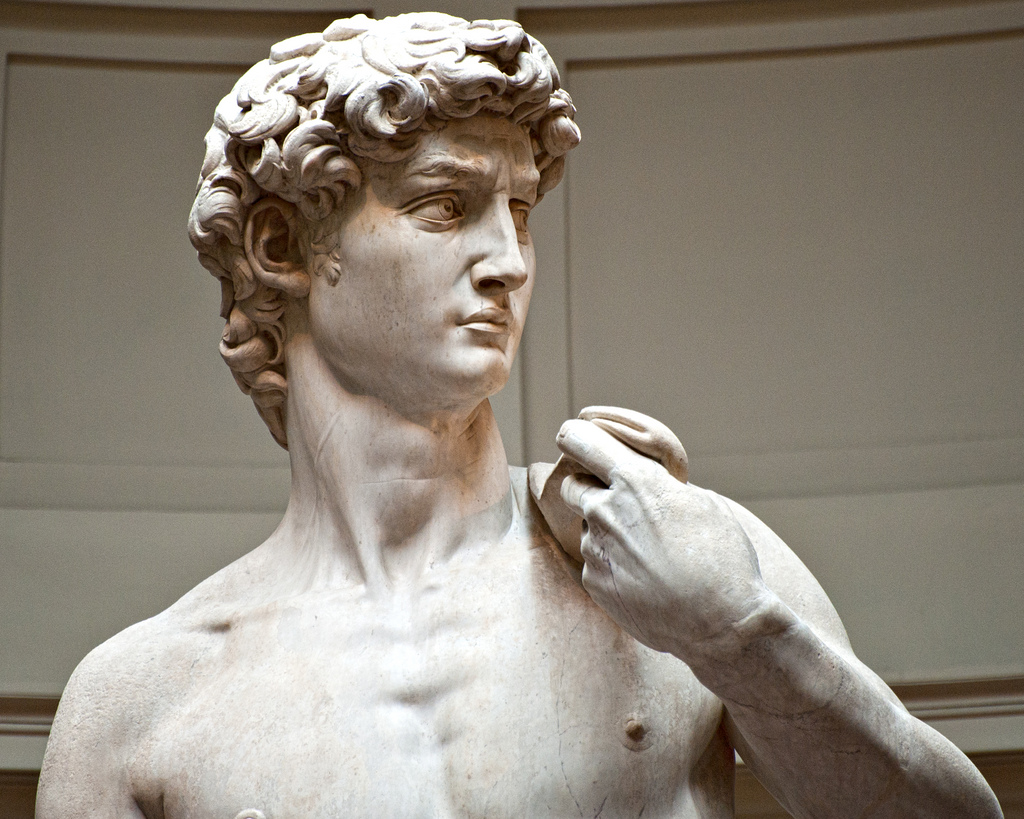
Pictured above we have the iconic statue of 'David' by Michaelangelo, and the bathetic 'Levitated Mass' by Michael Heizer. The former is the creation of excellent craftsmanship, a study of proportion and anatomy and ultimately the fruition of labour. The latter is - and let's be frank -a rock. Whereas artists of the past would carve their work in stone for the world to see, the modern artist skips the hard part and lets you carve your own opinions on it. What does this rock challenge? Is it daring or complex? No. Instead, the modern artist's work is to make a statement, not to make a statement through art. Standing under the rock and contemplating the closeness of death is a feeling which can be achieved by standing in the middle of the road, or putting a plastic bag over your head. Moreover, you can experience that for free! The estimated cost of the project? $10 million. In the pursuit of a relatively bland and boring statement, Heizer has wasted millions of dollars when he could have done so in a painting or sculpture for far less. However, I feel as if he may lack the artistic talent required in order to participate in conventional artistry, so I assume we should let this 71-year-old continue in his primary school antics. In fact it's no surprise that only ten days after the installation of this rock, the artist Mungo Thomson was commissioned to make 'Levitating Mass'. Levitating mass is a one-half scale helium balloon replica of this rock. The point is, not only is this work pointless, but it's not challenging. Anyone can do this. Some might say that it makes the subject of art more inclusive, but considering modern art is a profession for the washed up twenty-something with little desire to do anything, it's no surprise that the work they create is as alienating as those who make it. From what I read, the popularity of the piece is not so much in it's artistry than it is in the challenge of installing a 340 tonne boulder. 


This is a picture from 10th March 2012 when the installation was put into place. From a critical art perspective, what stands out most? The work of art, or the giant crane surrounding it? You may wonder why I have shown this photo, but it makes an excellent point. Whereas art used to be the intricate, fine and detailed work of a person of talent, modern art is instead a vast behemoth of an institution, which bears more resemblance to a factory than a studio. Has art purely become spectacle? A pursuit of Snapchat loving, Generation Y twenty-somethings? It seems to me that the popularity of this piece is based more on spectacle and the physical challenge of its installation rather than its artistic credibility. Then again, when an artist like Heizer is a genuine replica of a flip-flop it's no surprise. He is quoted as both saying "I come from an academic background. I wasn't raised to be into promoting myself" and "I wasn't an academic looking in books for ideas. But I educated myself." It seems as if the artist really is as opaque as his famous rock.

Modern artists, when compared to early-modern Aesthetic Relativists such as Monet, are not so much painting the reflections of lilies as they are attempting to paint reflections onto lilies. Some of you may be aware of the Goldsmiths Fine Art Graduate who deviously masterminded a project which entailed the theft and monetisation of one of Simon Starling's Rhododendrons, an almost perfect perpetrator of the aforementioned Frankenstein's Relativism. The graduate in question, Roisin Byrne, is filmed saying "I work with ideas. Ideas are my commodity, ideas are my product." You're probably wondering "I wonder what insightful and beauteous artwork she produced?"


Yes, you're not hallucinating, Byrne believes that transcripts of emails between herself and Starling are works of art. This 'piece' known as 'You don't bring me flowers anymore' goes for the unbelievably cheap price of £1500. To put that in perspective, many of Monet's 'Water Lilies' paintings were given to museums for free. To go into this further, a thief is selling ideas for £1500 whilst one of the 20th century's creative geniuses had his work given away for free. This is the vacuous no man's land between genius and greed. 'Conceptual art' is essentially a synonym for a distinct lack of talent and/or an intense avarice complex. The sad thing is that she sees her work as a 'product' to be replicated infinitely and to have no individual value. 

This is the point where I feel that I should elaborate further before I continue. Modern art is infatuated with money and the monetisation of ideas. The problem of course being that a wondrously charming Del-Boy couldn't sell these ideas to you in a Sunday morning market if he was giving them away for free. Despite their die-hard leftist leanings, these ultra-bourgeois egotists are in the business of production and not creation. Nowhere is this more present than in the work of Andy Warhol, an artist whose dedicated team of copy-pasting interns are nothing short of a particularly flaccid and impotent Ikea factory conveyor belt. And like the furniture, it's all a bit wank. We very much live in a Palahniukian age where the material value of an item gives it credence, where art is art because it is expensive.


The 'artwork' of a man who is responsible for such gems as "I am a deeply superficial person" and 
"Making money is art."
  

This leads me on to my second argument. The modern world loves mediocrity. If there's something which the modern world admires more than genius, it's a nobody with an art degree who can probably tell you more about Marxist Gender Theory than Louie Spence can tell you about lube.

Let me stress this again. Society LOVES mediocrity. No one is a 'winner' and it's the taking part that counts. Not only is this coddling, but it's also a most unbearable lie. Greg, who read the first chapter of Das Kapital over the summer holidays and wrote a pot-fuelled song about the capitalist pigs in The City, is not going to get as far in life as Sarah who's read the works of Hemingway and debates current affairs with both her friends and family. Stop pretending that Greg is on the same level as Sarah, he'll probably snap out of it when he's twenty five and he has to pay tax and get a job, but until then he's essentially a lost cause. Not only do we coddle the mediocre into a false sense of security, but then we bundle all of their insecurities and doubts into tight little packages and sell them to them as 'commodities' or 'products.' The mass production of art for 'the masses' is not only one of the greatest perversions of art as a discipline, but also one of the greatest perversions of intellectualism. You aren't smart for owning a Warhol, a Prius and a Go-Pro, you've just succumbed to the same neo-liberalist capitalism you fight against in rallies. 

It seems these days that artists are being taught how to think rather than to paint or sculpt. In contrast, the great works of art are inspired by both an intellectual and artistic vigour. Moreover, I had always considered thinking as an organic process which cannot be taught; there is no one way to think, in the same way that there is no one way to paint. I suggest that you watch the BBC 4 Documentary "Goldsmiths: But is it Art?" and watch the vacuous stupidity which these artists are being taught. They come out more stupid than they come in and with less artistic talent. It's sad because those who do decide to paint have skill, and it's obvious, but it's the paintings with meaning which are valued by the lecturers. Artistic skill is very much sidelined. Whereas classical art's focus was on the innovation of technique and style in order to create more beautiful and sophisticated works, modern art is primarily interested in invention: an invention of meaning, statement and inclusion. But can anyone really be included into the artistic circle if its modus operandi is ideas first and artwork second? The pseudo-nihilistic qualities of these people's thinking leads to pseudo-nihilistic work which is, for the most part, pointless. You do not need skill to make art if you view art as pointless in the first place. 

Without a system which strives for excellence, there is no way to objectively say a work of art is good or bad. Some may argue that this is fine, but for me this is very much the crux of the problem. Without a standard of excellence, mediocrity becomes king. In many ways, modern artists sell the mediocre an Emperor's New Suit - a modern interpretation of an ancient, yet simple idea. People are petrified of being called ignorant or stupid for challenging what is obviously a con, or at the very least a distinct lack of skill, so nod their heads and pretend they understand as if they were being told this all in Russian. 
 Like most sensible people, you probably lost interest in modern art about the time that Julian Schnabel was painting broken pieces of the crockery that his wife had thrown at him for painting broken pieces of crockery instead of painting the bathroom and hall.
Read more at: http://www.brainyquote.com/quotes/keywords/modern_art.html
Like most sensible people, you probably lost interest in modern art about the time that Julian Schnabel was painting broken pieces of the crockery that his wife had thrown at him for painting broken pieces of crockery instead of painting the bathroom and hall.
Read more at: http://www.brainyquote.com/quotes/keywords/modern_art.html

Like most sensible people, you probably lost interest in modern art about the time that Julian Schnabel was painting broken pieces of the crockery that his wife had thrown at him for painting broken pieces of crockery instead of painting the bathroom and hall.
Read more at: http://www.brainyquote.com/quotes/keywords/modern_art.html
Like most sensible people, you probably lost interest in modern art about the time that Julian Schnabel was painting broken pieces of the crockery that his wife had thrown at him for painting broken pieces of crockery instead of painting the bathroom and hall.
Read more at: http://www.brainyquote.com/quotes/keywords/modern_art.html

So, I've rambled on now for an adequate amount of time. Are you convinced? Perhaps not, and that's fine, as long as you're happy. But remember this; there is a reason that there is a semiotic relation between art and artists such as Picasso, van Gogh, Dalí, Monet e.t.c. and it's not difficult to say why. These artists have talent, artistic as well as intellectual. Modern artists very much see art as a free-market economy of ideas for sale. The difference is best phrased in the context of the Parnassian motto 'art pour l'art' or art for art's sake. This term was coined by the poet Théophile Gautier who, it may interest you to know, is on the wall of Andy Dufresne's prison cell in The Shawshank Redemption. The placement of his picture discusses the freedom of simplicity, the ability to carve your future and ultimately, highlights  Andy Dufresne's characteristic intelligence. Anyone who has seen the film will know that Andy Dufresne is the owner of the two key facets in a great artist: skill and intelligence. This is ultimately the crux - by side-lining or ignoring one, Dufresne would never have escaped prison. In the same light, by ignoring artistic skill or intellect, you cannot be a great artist.

This is fundamentally why I argue that you should be able to enjoy a work of art for what it is. If there is no aesthetic skill or understanding being displayed in the work you examine, then what does it really say to you? Concurrently, a work without intellect should also be criticised. In many cases I would suggest that modern art has a tendency to forget both, highlighting both modern art's mediocrity and it's pseudo-intellectualism. 

Thursday, 30 April 2015

How Far Can We Trust the Media?

How Far Can We Trust the Media?


The average Briton currently consumes roughly 8 hours and 41 minutes of  media every day, while only sleeping for 8 hours and 21 minutes according to communication regulator Ofcom - 4 hours of that is the consumption of television media and entertainment. Furthermore, the same study showed that six-year-olds have the same level of technological knowledge as most 45-year-olds; not only are we consuming more information each and every day, we are also learning how to consume it and where to find it at a far younger age. Further evidence for this is increasingly surprising- the 16-24 demographic are capable of consuming 14 hours of media in a 9 hour time period by multitasking - and your parents said you were lazy! 

With an unprecedented level of information at our fingertips, and an increase in the supply of our entertainment and media it's important to ask: How far can we trust the media? These, after all, are the people who teach us almost everything that we know (despite the best efforts of teachers) about the modern world. The truth isn't particularly promising.

In 2008, the BBC documentary series 'Panorama' aired a piece claiming that the Bangalore- based suppliers of Primark's clothing were using child labour in order to create their various products. Not only was this story proven to be 100% slanderous, the footage that they used in the show was STAGED. The BBC, an iconic household name in British people's hearts, who we pay television licence to in order to access their content, has openly lied to us. But this isn't the end of it- BBC News used a photograph from Iraq in 2003 to portray a Syrian massacre in 2012 - one might argue this is just lazy journalism, but if our journalists are willing to cut corners in order to provide easy stories and we know that they have lied to us before, what's to say that they don't doctor information all of the time? 

For example, BBC Newsnight were complicit in the spreading of false child abuse claims about the politician and adviser to Thatcher, Lord McAlpine. This in turn saw the resignation of  the BBC's Director-General George Entwistle. Stories like this ask whether or not the BBC is an organisation of objectivity. Now, before I make you explode, I know that it's outstandingly easy to call the BBC left-wing sympathisers but considering the manner in which they have doctored stories to highlight child labour, war atrocities and paedophilia, one has to wonder how trustworthy the BBC truly is. Moreover, we must be wary of a left leaning political bias which, one could argue, exists within the organisation. Objectivity in our media gives us the ability to think organically. The nature of a newspaper's 'spin' on a story colours our view of any possible event, and it's all down to the political stance of the provider, as well as that of the consumer.

Let me be frank. No trial of the media is complete without the barmy army of the right-wing press. With multinationals like News Corp owning multiple British newspapers such as The Sun and The Times, 50% of the American Foxtel News-Corp and almost every significant newspaper in Australia, it's no wonder that there has been a general homogenization of the right-wing press since the mid 20th century. News International, a subsidiary of the  News Corp corporation, was infamously engaged in phone hacking, police bribery and the exercising of improper influence within news stories. Whilst this seems wrong in itself, the journalists recorded the phone and text conversations of dead British soldiers and victims of the 7/7 bombings in 2005 - a distinct lack of humility has been shown by these journalists and rightly led to the closure of the News of the World newspaper and forced News Corp to back down from their attempts to purchase BSkyB.

Unlike the BBC, newspapers have no obligation to at least present themselves as objective, which generally leads to the right-wing going bananas with it all, and the liberal-left moaning about almost anything they can get their hands on. With The Sun posting taglines such as 'Evil in the name of Islam MUST STOP' it is relatively easy to point out the right-wing, anti-immigration agendas presented to us by The Sun and similar newspapers. Not only are comments like this inflammatory, but are also subtle hints of the institutional Islamophobia of the traditional Judeo-Christian Right. On the other hand, papers like The Guardian have equally outlandish messages- a recent example being a column by Dawn Foster which reads 'Leaked Tory plans to cap child benefits have the whiff of eugenics about them' on the basis that it condemns the poor by lowering child benefits once they have two children. Counter-intuitively, columnists like Dawn desire to reduce our Carbon Footprint whilst increasing the world's already vast population. Dawn's vacuous 'pie-in-the-sky' school of perplexing 'Greenisms' don't do any favours for those looking to create objective views on key policy issues. 

Every time that we access media of any variety, the information presented has been carefully selected and recreated in order to present 'Photoshoped' versions of the news. In the same way that Photoshop artists use 'signature' effects, particular writers and editors will always add a much nuanced edge to the information we consume. If you look hard enough, you can find the contrapositive or opposite of any particular event- take the election debates for example. The right-wing were quick to slam Ed Miliband, most peculiarly for leaving his script for policy in his changing room, which they argued made him look 'robotic'. Simultaneously, the left were quick to point out that Cameron hadn't dealt particularly well with the interview, even though the pro-Conservative Paxman was asking the questions- remembering that he was in fact asked to become an MP by the Conservative Party (I'll come back to Paxo later).  

Despite all of the things I have said, there is an argument in favour for such a diversity of news- the difference in opinion shows us the spectrum of views within our society, and in fact can lead to more interesting revelations about the political landscape of the UK than the news itself. The Sun and The Daily Mail were the only two newspaper in the UK with a physical circulation above a million copies in 2015. The survival of these newspapers, despite the large transferral of circulation to digital media, indicates a strong presence of  right-wing politics in British society, which is almost certainly apparent in the support for both the Conservatives and more recently UKIP.

The vast array of news placed before us makes the ability to understand the world (in terms of hard solid facts) nearly impossible. Furthermore, the digital age makes every image or news story we read suspect; war becomes theatre for the masses, with political spins either condemning or praising military action, and famine becomes the latest magazine cover for a generic magazine. Our vast surfing experience has taught us to believe that not all of the information that we process is true and we become desensitised to it all. Every image or story we consume may have been staged, recreated or exaggerated for political agendas. Not only this, but the increasing importance of advertising and marketing within British media overwhelms us with possible interpretations of any given event or product. News channels may collude with the beauty industry to suggest that the weather will be 'hot hot hot!' in order to increase the sales of sun-tan creams. We just simply cannot examine every single article of information that we are presented with and know with certainty whether or not the product has an ulterior motive.

To this extent, it is extremely easy to follow just one newspaper- you know roughly what you're going to get, whether you agree with the writers and the topics that you are likely to encounter. This is where we see the big danger- unconscious consumption of media will lead to marketing brainwashing, a lack of intuitive, independent thought and most importantly a lack of objectivity. This is what media companies want us to do: turn on, tune in, drop out. A key example of this would be the almost infamous Newsnight. But what we don't think about whilst we watch Britain's most cynical man host this sacred cow institution are these things: the spin the BBC wants to put on any story, Paxman's political biases (unintended or purposeful) or the news that the BBC wants you to hear. Not only do news corporations put spins on our news, but they careful cherry-pick it in order to embolden their views and agendas. 

So, are we to blame the media corporations for making us subjective consumers of imperfect information? Of course not, if anything, our general laziness and high self-worth are to blame. How can a society which spends more time consuming media than sleeping be expected to ever step back and 'think'- we are already using almost 17 hours of a 24 hour day consuming media and sleeping, so how are we ever supposed to analyse and evaluate the media which we consume? As a society which increasingly spends it's time rushing to nowhere, our consumption of media becomes less and less objective- we learn to accept the views of the writer because we don't believe that it would be time well spent to think objectively. 

This in essence is the animus of the problem. Media producers want to push certain views, and they know that consumers are increasingly more willing to accept the news that they read to be true; the modern world has taught us to be more critical of information, but the effort required to sift through and evaluate the quantity of information that we process is simply too taxing. Regardless, the media companies aren't concerned. We get our news, and they achieve their goals. 

So, to answer our question: no, we can't trust our media. Moreover, we can't trust ourselves. We are simply lazy consumers- we would rather be told imperfect knowledge in huge quantities than precise information in lesser quantities. Whilst I would like to say that humanity can rise above this and that the public will become more critical consumers of information, it seems increasingly unlikely. I suggest that you just bear in mind that it may be more beneficial to you if you consume crucial information in less quantity, with higher objectivity, than a mixture of cat videos and 60 second updates in your eternal quest to conquer the internet.

Wednesday, 29 April 2015

The Immigration Game

THE IMMIGRATION GAME


In the run up to the 2015 General Election, it is fair to say that immigration has become a dominant issue, tantalising the tip of every interviewer's tongue. A large number of people are actively seeking tougher anti-immigration laws, arguing that the UK is becoming overcrowded. But here's the thing- if a politician is asked what they will do to deal with immigration, most will spew out a copy and paste generic answer such as 'Immigration does a lot for our country, but we need to control it'. Satisfactory I suppose, but why has immigration suddenly - over the last few years- become such an important and inflammatory issue for so many Britons?  

Besides the economy and the NHS, good immigration policy is one of the primary methods of gaining political support in modern Britain- the Labour party infamously launching their 'Controls on immigration' mugs earlier this year. After the industrial boom of UKIP in the last few years, polls suggesting UKIP support may be as high as 18%, party political agendas have quickly evolved to reflect the perceived increase in a public outcry for tougher immigration laws; the Tories plan to clamp down on Health Tourism, bogus colleges, dodgy work placements and implement a new civilian test, whilst the ever accommodating Liberal Democrats pledge to 'secure our borders' and tighten up on Visa exploitation.

Political leaders are talking about how 'tough' they are when it comes to immigration, and that their party is the 'only party' which can solve the problem. Essentially, they all say they are going to lower immigration, so it seems that the mainstream British parties have amalgamated into a cytoplasmic immigration-consensus blob. To be brutally honest, you can't blame them! A recent poll by the University of Oxford's 'Migration Observatory' show a general consensus for stronger policy on immigration, with 55% of respondents wishing to reduce immigration 'a lot'. 


Many Britons are bombarded by messages from the right-wing press telling them that immigrants have 'Stolen all our jobs' (The Star), that we're 'right to worry' about asylum seekers (Daily Mail) and that 'One in five Britons will be ethnics' by 2050 (Daily Express). The press churns out the same stories that it always does- the profitable ones. We all know that a paper tagged with the headline 'Immigration endangering our future' is going to grab the attention of the British population more effectively than 'Muslim communities condemn ISIS'. We know that one story is spun negatively, yet we still chose to read it- why?. The drudgery of 21st century living is overwhelmingly apparent, and the technological ages' ability to provide instant gratification and entertainment has desensitised us to the everyday acts of dignity, which is many respects are more poignant than the scare-stories of the Murdoch Monopolies. People like to believe that there is something happening in their lives, and moreover, that THEY are involved in this pivotal event, even if it is the seemingly dull topic of immigration.

In even stranger circumstances, it is the elderly who tend to be the most afraid of the 'oncoming wave' of immigration, even though they are the least likely to be effected; they aren't competing for jobs with migrant workers, or against a 21-year-old Polish plumber to live in Anglesea Heights Care Home.The graph below showing how apparent the difference in opinion varies with age.


Furthermore, opposition towards immigration is highest in areas which are home to the lowest level of migrants. Take, for example, the recent triumphant by-election constituency of Clacton in October 2014, now represented by UKIP's Douglass Carswell. According to the last government census, fewer than 1/20 of Clacton's population are migrants, yet the primary reason for the change in MP, according to UKIP, was the 'fear of invisible immigrants'. Unless  boats full of desperate North Africans who are seeking sanctuary  in the UK have been constructing a secret underground city beneath the town or asked Harry Potter if they could borrow his famous cloak, it seems that this level of fear towards migrants is unjustified. Obviously one could argue that it's only natural that in places such as London, where diversity is dominant in the cultural animus of the city, opposition to immigration will naturally be lower, and that the constituents of Clacton are yet to go through the 'diversification process'. But in reality, it's highly unlikely that immigrants are ever going to replace the populace of the white, middle class Clacton town. Considering that 2/3 of London BAME (Black Asian Minority Ethnic) constituents feel as if minorities living have been through more difficult economic strains during the recent recession, in a city which is highly tolerant of immigration, it seems unlikely that the foreign hordes will set up camp in Clacton town.

It seems then that we have reached a strange point- if the right-wing press and political class are telling us how important immigration is as an issue, whilst the British public cry out for tougher immigration policy, who is responsible for immigration hysteria? Think of it like this- immigration policy is a ginormous Edwardian steam train, with the British people at the helm and the political bods shoveling the coal into the fire. The British people are demanding that immigration policy has to go further and faster, so politicians implement tougher immigration policy more frequently and at faster rates. 

Mr Farage has led us to believe that the sway in public opinion is due to the 'Purple Revolution' and that the view is a reflection of increasingly high levels of immigration. Mr Farage is correct to say that there is an increasing level of immigration - there have been statistically significant increases for immigration among non-EU citizens (up 49,000 to 292,000) between 2014 and 2015 showing concern even for those most in favor of immigration.

But here's the big problem- did this really fuel a public led demand for tougher immigration? Is it even a new phenomenon?

In 1978, a survey conducted by the research firm Gallup discovered that over 70% of the British public believed that the nation had been 'Swamped' by immigrants, even though net migration in the same year stood at -50,000 : there were more people saying bon voyage to Britain than entrants to the UK! Furthermore, net migration had been negative since 1965. What do we learn from this? Well firstly that UKIP's rise to power seems far less impressive- waves of anti-immigration seem to be cyclical in the same way that that the British economy goes through natural cycles of recession and boom, with views on immigration having questionable correlation with the level of migration. Secondly we learn that, as much as we would like to believe that it is the politicians who are to blame (which I shall come back to later) the British public are primarily culpable. You may remember me earlier talking about how important a sense of excitement, a sense of being alive was in capturing the interest of the British population. We are complicit in the consumption of The Immigration Game- that's all it is to politicians; they are able to change their official view on immigration policy as and when they wish, as and when you ask for it. Politicians, as much as we would like to blame them, are only facilitating our demand for stronger immigration policy. Whilst they should educate the public about the true nature of immigration, they have no obligation to do so and are happy to supply at the level at which we as a society demand, as if they were some behind-the-bikeshed drug dealer.

This begs an even greater question- why do we have such strong views against immigration as a society? Do I dare even say it, bring up the elephant in the room? Is it possible, God forbid that Britain is ever so slightly...racist? Well, a recent YouGov poll indicates that this slightly shocking statement may be true.


51% of UKIP supporters believe that the government should encourage immigrants to 'leave Britain', even if their children are British citizens by law. Despite UKIP's best attempts to suggest  they accept that the children of migrants are equal British citizens, with such a significant number of supporters being so passionate  on the issue, is it only a matter of time before this sort of Xenophobia becomes public policy? Not only this, but a quarter of British adults agree with the statement. This, however you try to twist it, shows that something is inherently wrong with our society- as a civilization which prides itself on  its diversity and progressive policy, why does such a large level of antipathy exist among a quarter of our citizens? Is it possible that, and I can't believe I'm saying this, fringe parties such as the BNP *vomits profusely* will see a similar rise to power in the coming years? 

I don't have the answers, but rest assured neither do the far right and their increasingly toxic views on immigration. A vast majority of the immigration debate has been melodramatically negative, highly vindictive of the British press and the right-wing political class.

I'm going to introduce a house rule into The Immigration Game, it's called 'The other side of the argument'. Why is immigration good, why should we treasure its existence? Well, University College London predicts that new migrants add £5 billion a year into the tax pot- and before you scream 'they took ours jobs', I highly suggest you watch the documentary 'Poles to Peterborough' which highlights the general laziness of British workers and the exceptional work ethic of immigrants in the UK, as well as the repulsive nature of the work that they take up- the vast majority of sewer workers in London are first generation immigrants. Furthermore, a Briton is far more likely to receive benefits than any immigrant, as seen in the chart below. 

Immigrants also receive less in benefits than the 30,000 Britons living abroad, still covered by our benefits scheme. Unfortunately, humans like to create scapegoats in order to escape the truth of what's really happening in the world- American lobbyists claim that climate change is a lie and that it is just a repetition of the 'natural cycle' whilst the icebergs melt at unprecedented rates, gun lobbyists claim that the removal of guns inhibits Americans rights to freedom, whilst the US has the highest level of gun crime in the world, video games and rap music are to blame. The British public needs to sharpen up and learn the facts- immigration is not as bad as many want to believe it is. It may be boring to say it, because it removes the suspension of disbelief that the modern era has enshrouded us in, but it is critical in the realisation that if we reluctantly stroll towards meaningless, inequitable immigration policy that we may end up living in a place we no longer want to call 'home'. Politicians also have a responsibility to educate the British public, but it is not in their interests to do so - their primary concern is your vote, regardless of whether or not what you believe is true or whether it is the just thing to do. 

All I ask of you is this: educate yourself, learn as much as you possibly can about the true value of immigration, and if you are still enticed by the arguments for tougher anti-immigration, then at least you can justify your argument. 

A big influence in the writing of this article was a piece by Mehdi Hasan in The Guardian- though I don't think he got it quite right, I did use some of his statistics in this article.