When all is said and done, does anyone actually think that it's good?

I think that my argument boils down to two fundamental concepts. The first is that most people who talk about the 'intricacies' and 'genius' of modern art have fabricated those notions in the manner of an extremely rambunctious sophist. Anyone who holds the same position as myself is likely to have come across the argument 'you just don't understand' or some variation of this most original and insightful comment. More articulate critics and art scholars (not some washed up twenty-something, gap-year espousing Shoreditch vegan) would point you to Aesthetic Relativism. Aesthetic Relativism is, in many ways, the pre-cursor to the Body-Positive movement and our culture's quasi-erotic desire for mediocrity. By this I mean that, whilst it may make you feel happy that someone out there likes you or your work, it does not necessarily mean that you or your work is good and/or important. Moreover, most of the people who do like your work are probably as talentless or as lost as yourself, if not more so (a position I implore you to hold in relation to my work if you're not convinced.) .
Forgetting the flippantry, Aesthetic Relativism is, in short, the notion that beauty is in the eye of beholder. The classical artistic notion of objectivism in relation to the Methods of the Masters (demanding the highest level of excellence, improving on the work of previous masters and aspiration to the highest attainable quality) has been, for the most part, drowned in a Pollockesque puddle of pseudo-intellectualism based on the basic principles of Aesthetic Relativism. I think it's for this reason that modern art loses itself on the majority of people, let alone objective thinkers. In the words of the satirist P.J. O'Rourke "Like most sensible people, you probably lost interest in modern art about the time that Julian Schnabel was painting broken pieces of the crockery that his wife had thrown at him for painting broken pieces of crockery instead of painting the bathroom of the hall." O'Rourke has a point: pre-cursors to modern art such as van Gogh or Dalí are loved and celebrated for their artistic talent and innovation, not their life stories.

van Gogh's 'Starry Night over the Rhone'
Even a brief viewing of these works shows intense artistic skill and originality. The bold and blatant strokes of van Gogh fragment a relatively simple view of the Rhone; the surreal and intricate reflection of strong vertical lines of light against the overtone of horizontal sky and river really defines this image, there is visible artistic skill and sophistication here, mimesis is comprehensible. The time and effort is palpable, the strokes of paint at once seemingless and painstaking, creating a complex yet aesthetically pleasing piece. There is discipline in design and execution, in the same way that an orator designs and executes excellent rhetoric.

Dalí's 'The Disintegration of the Persistence of Memory'
Dalís work shows an even greater understanding of proportion, a divergent concept of form and composition on canvas, yet the ultimately fascinating and complex scene presented to us still leaves us asking questions. In many ways, the human condition is reflected excellently in this painting; a deconstruction of an earlier painting 'The Persistence of Memory', the themes of uncertainty, distortion, existentialism and aestheticism are all highlighted in the excellently crafted melting clocks, or even the commendable re-creation of an earlier piece's elements.
Now, let's make one thing clear. Both of these artists would be considered Aesthetic Relativists. Both distort the classical concept of a 'pureness' or the attempt at 'perfect' replication. But this is, ultimately, ivory tower intellectualism. These works are excellent because, despite their surrealism, they are veritably gorgeous paintings. A viewer can note and explain artistic credibility with extraordinary prowess being shown in both. Where then, is the division between these artistic greats and the art we see today?
The problem is, modern art has latched onto modern culture. We're too afraid to be critical in case we hurt someone's feelings. We live in a world where criticising the Chinese government's systematic oppression of political prisoners can be construed as 'insensitive' because of cultural differences, despite artists such as Ai Weiwei portraying cries of desperation in their work. 'Fashion experts' applaud anorexic, abused girls in bin bags whilst the rest of the world watches on with confusion and horror. Modern culture is built for modern people, modern people of course being their own class of pseudo-intellectual 'not-quite-smart-enough' twenty-somethings who think that genius is asking questions and making statements. Children ask questions, animals are inquisitive. Questions aren't inherently intellectual, and certainly not novel. Anyone can make a statement, but your statement is only meaningful if it contributes to society or challenges intellectual thought. For some reason we have, in recent times, removed art from art. Art is now thought, and paintings just a coalescence of crusty oils hanging on the walls of ancient and respected institutions. What happened to the application of intellectualism to skill and expertise with the latter being the foundation of all good art?
This is not to say that asking questions or making statements are frivolous, but they are if you attempt to remove them from skill and suggest that they are art. This is, quite simply, a ridiculous concept; the marketplace for verbal or written artwork is in the literary world in novels, poetry or even in music. Art as a concept obviously covers all forms of artistic forms, but when specifically speaking of 'works of art' it does a genuine disservice to gifted artists when it is suggested that the GCSE standard prose of an art graduate can be compared to David, Picasso or Rembrandt.
Ultimately, modern art's desperate attempt to reflect the human condition has led to the creation of an alchemical, Shellian house of mirrors: the audience and the artist spend a vast amount of time seeing bizarre machinations of their person before admitting to themselves that they are lost, promptly asking the steward to lead them back into the real world. Unlike Dalí or van Gogh, the importance of artistic credibility is sidelined in place of thought and opinion with the credo being that all opinions are valid. In the context of a debate or essay, this is only true if you can substantiate your claims. In my opinion, and that of many others, this is applicable in a similar way to the artistic credibility of an artist. The art historian Jakob Rosenberg phrases it best when he says that the quality of art "is not merely a matter of personal opinion but to a high degree...objectively traceable." You are not necessarily a chef if you have an opinion on the treatment of ducks in foie gras production, in the same way that you're not an necessarily an expert on the Middle East if you called someone Islamophobic once. This is to say, purely because you have an opinion on something, you are not necessarily an expert or an artist (a claim which I would not dare to make about myself in relation to artistic talent, I very much have a case of Doctor's Handwriting.)
Now, if you're a naysayer and think I still haven't proven why modern art is bad, I think now is the time to put the case to bed. Many people, even those who do think modern art is a bit naff, very much believe that 'art is opinion' or openly flirt with the question 'what is art?' These concepts have ultimately challenged the concept of what objectively good art is, for better or for worse. Naturally, I believe it has been done so for the worse. Why? Well, a brief comparison of two pieces of art; one a piece made under the philosophy of Universal Standards (see Methods of the Masters) and another under the philosophy of Artistic Relativism (by which of course I refer to the modern art I am challenging, not early relativists who still pursued an excellence of craft.)
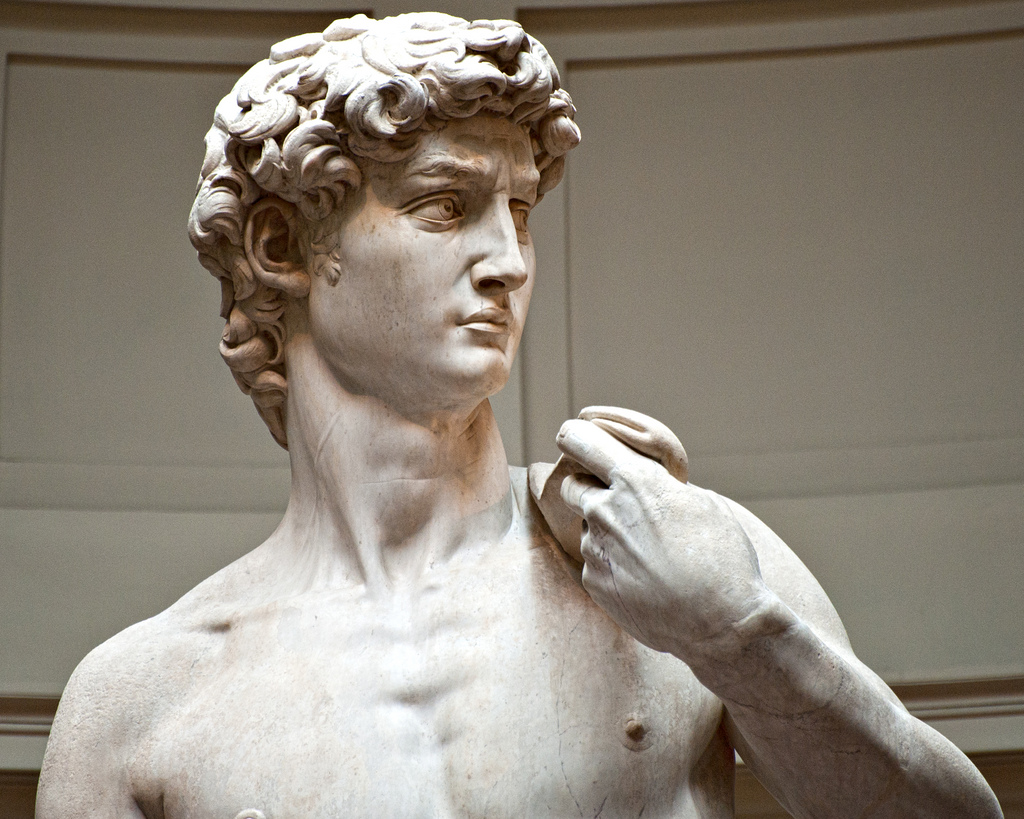

Pictured above we have the iconic statue of 'David' by Michaelangelo, and the bathetic 'Levitated Mass' by Michael Heizer. The former is the creation of excellent craftsmanship, a study of proportion and anatomy and ultimately the fruition of labour. The latter is - and let's be frank -a rock. Whereas artists of the past would carve their work in stone for the world to see, the modern artist skips the hard part and lets you carve your own opinions on it. What does this rock challenge? Is it daring or complex? No. Instead, the modern artist's work is to make a statement, not to make a statement through art. Standing under the rock and contemplating the closeness of death is a feeling which can be achieved by standing in the middle of the road, or putting a plastic bag over your head. Moreover, you can experience that for free! The estimated cost of the project? $10 million. In the pursuit of a relatively bland and boring statement, Heizer has wasted millions of dollars when he could have done so in a painting or sculpture for far less. However, I feel as if he may lack the artistic talent required in order to participate in conventional artistry, so I assume we should let this 71-year-old continue in his primary school antics. In fact it's no surprise that only ten days after the installation of this rock, the artist Mungo Thomson was commissioned to make 'Levitating Mass'. Levitating mass is a one-half scale helium balloon replica of this rock. The point is, not only is this work pointless, but it's not challenging. Anyone can do this. Some might say that it makes the subject of art more inclusive, but considering modern art is a profession for the washed up twenty-something with little desire to do anything, it's no surprise that the work they create is as alienating as those who make it. From what I read, the popularity of the piece is not so much in it's artistry than it is in the challenge of installing a 340 tonne boulder.

This is a picture from 10th March 2012 when the installation was put into place. From a critical art perspective, what stands out most? The work of art, or the giant crane surrounding it? You may wonder why I have shown this photo, but it makes an excellent point. Whereas art used to be the intricate, fine and detailed work of a person of talent, modern art is instead a vast behemoth of an institution, which bears more resemblance to a factory than a studio. Has art purely become spectacle? A pursuit of Snapchat loving, Generation Y twenty-somethings? It seems to me that the popularity of this piece is based more on spectacle and the physical challenge of its installation rather than its artistic credibility. Then again, when an artist like Heizer is a genuine replica of a flip-flop it's no surprise. He is quoted as both saying "I come from an academic background. I wasn't raised to be into promoting myself" and "I wasn't an academic looking in books for ideas. But I educated myself." It seems as if the artist really is as opaque as his famous rock.
Modern artists, when compared to early-modern Aesthetic Relativists such as Monet, are not so much painting the reflections of lilies as they are attempting to paint reflections onto lilies. Some of you may be aware of the Goldsmiths Fine Art Graduate who deviously masterminded a project which entailed the theft and monetisation of one of Simon Starling's Rhododendrons, an almost perfect perpetrator of the aforementioned Frankenstein's Relativism. The graduate in question, Roisin Byrne, is filmed saying "I work with ideas. Ideas are my commodity, ideas are my product." You're probably wondering "I wonder what insightful and beauteous artwork she produced?"

Yes, you're not hallucinating, Byrne believes that transcripts of emails between herself and Starling are works of art. This 'piece' known as 'You don't bring me flowers anymore' goes for the unbelievably cheap price of £1500. To put that in perspective, many of Monet's 'Water Lilies' paintings were given to museums for free. To go into this further, a thief is selling ideas for £1500 whilst one of the 20th century's creative geniuses had his work given away for free. This is the vacuous no man's land between genius and greed. 'Conceptual art' is essentially a synonym for a distinct lack of talent and/or an intense avarice complex. The sad thing is that she sees her work as a 'product' to be replicated infinitely and to have no individual value.
This is the point where I feel that I should elaborate further before I continue. Modern art is infatuated with money and the monetisation of ideas. The problem of course being that a wondrously charming Del-Boy couldn't sell these ideas to you in a Sunday morning market if he was giving them away for free. Despite their die-hard leftist leanings, these ultra-bourgeois egotists are in the business of production and not creation. Nowhere is this more present than in the work of Andy Warhol, an artist whose dedicated team of copy-pasting interns are nothing short of a particularly flaccid and impotent Ikea factory conveyor belt. And like the furniture, it's all a bit wank. We very much live in a Palahniukian age where the material value of an item gives it credence, where art is art because it is expensive.

The 'artwork' of a man who is responsible for such gems as "I am a deeply superficial person" and
"Making money is art."
This leads me on to my second argument. The modern world loves mediocrity. If there's something which the modern world admires more than genius, it's a nobody with an art degree who can probably tell you more about Marxist Gender Theory than Louie Spence can tell you about lube.
Let me stress this again. Society LOVES mediocrity. No one is a 'winner' and it's the taking part that counts. Not only is this coddling, but it's also a most unbearable lie. Greg, who read the first chapter of Das Kapital over the summer holidays and wrote a pot-fuelled song about the capitalist pigs in The City, is not going to get as far in life as Sarah who's read the works of Hemingway and debates current affairs with both her friends and family. Stop pretending that Greg is on the same level as Sarah, he'll probably snap out of it when he's twenty five and he has to pay tax and get a job, but until then he's essentially a lost cause. Not only do we coddle the mediocre into a false sense of security, but then we bundle all of their insecurities and doubts into tight little packages and sell them to them as 'commodities' or 'products.' The mass production of art for 'the masses' is not only one of the greatest perversions of art as a discipline, but also one of the greatest perversions of intellectualism. You aren't smart for owning a Warhol, a Prius and a Go-Pro, you've just succumbed to the same neo-liberalist capitalism you fight against in rallies.
It seems these days that artists are being taught how to think rather than to paint or sculpt. In contrast, the great works of art are inspired by both an intellectual and artistic vigour. Moreover, I had always considered thinking as an organic process which cannot be taught; there is no one way to think, in the same way that there is no one way to paint. I suggest that you watch the BBC 4 Documentary "Goldsmiths: But is it Art?" and watch the vacuous stupidity which these artists are being taught. They come out more stupid than they come in and with less artistic talent. It's sad because those who do decide to paint have skill, and it's obvious, but it's the paintings with meaning which are valued by the lecturers. Artistic skill is very much sidelined. Whereas classical art's focus was on the innovation of technique and style in order to create more beautiful and sophisticated works, modern art is primarily interested in invention: an invention of meaning, statement and inclusion. But can anyone really be included into the artistic circle if its modus operandi is ideas first and artwork second? The pseudo-nihilistic qualities of these people's thinking leads to pseudo-nihilistic work which is, for the most part, pointless. You do not need skill to make art if you view art as pointless in the first place.
Without a system which strives for excellence, there is no way to objectively say a work of art is good or bad. Some may argue that this is fine, but for me this is very much the crux of the problem. Without a standard of excellence, mediocrity becomes king. In many ways, modern artists sell the mediocre an Emperor's New Suit - a modern interpretation of an ancient, yet simple idea. People are petrified of being called ignorant or stupid for challenging what is obviously a con, or at the very least a distinct lack of skill, so nod their heads and pretend they understand as if they were being told this all in Russian.
Like most sensible
people, you probably lost interest in modern art about the time that
Julian Schnabel was painting broken pieces of the crockery that his wife
had thrown at him for painting broken pieces of crockery instead of
painting the bathroom and hall.
Read more at: http://www.brainyquote.com/quotes/keywords/modern_art.html
Read more at: http://www.brainyquote.com/quotes/keywords/modern_art.html
Like most sensible
people, you probably lost interest in modern art about the time that
Julian Schnabel was painting broken pieces of the crockery that his wife
had thrown at him for painting broken pieces of crockery instead of
painting the bathroom and hall.
Read more at: http://www.brainyquote.com/quotes/keywords/modern_art.html
Read more at: http://www.brainyquote.com/quotes/keywords/modern_art.html
Like most sensible
people, you probably lost interest in modern art about the time that
Julian Schnabel was painting broken pieces of the crockery that his wife
had thrown at him for painting broken pieces of crockery instead of
painting the bathroom and hall.
Read more at: http://www.brainyquote.com/quotes/keywords/modern_art.html
Read more at: http://www.brainyquote.com/quotes/keywords/modern_art.html
Like most sensible
people, you probably lost interest in modern art about the time that
Julian Schnabel was painting broken pieces of the crockery that his wife
had thrown at him for painting broken pieces of crockery instead of
painting the bathroom and hall.
Read more at: http://www.brainyquote.com/quotes/keywords/modern_art.html
Read more at: http://www.brainyquote.com/quotes/keywords/modern_art.html
So, I've rambled on now for an adequate amount of time. Are you convinced? Perhaps not, and that's fine, as long as you're happy. But remember this; there is a reason that there is a semiotic relation between art and artists such as Picasso, van Gogh, Dalí, Monet e.t.c. and it's not difficult to say why. These artists have talent, artistic as well as intellectual. Modern artists very much see art as a free-market economy of ideas for sale. The difference is best phrased in the context of the Parnassian motto 'art pour l'art' or art for art's sake. This term was coined by the poet Théophile Gautier who, it may interest you to know, is on the wall of Andy Dufresne's prison cell in The Shawshank Redemption. The placement of his picture discusses the freedom of simplicity, the ability to carve your future and ultimately, highlights Andy Dufresne's characteristic intelligence. Anyone who has seen the film will know that Andy Dufresne is the owner of the two key facets in a great artist: skill and intelligence. This is ultimately the crux - by side-lining or ignoring one, Dufresne would never have escaped prison. In the same light, by ignoring artistic skill or intellect, you cannot be a great artist.
This is fundamentally why I argue that you should be able to enjoy a work of art for what it is. If there is no aesthetic skill or understanding being displayed in the work you examine, then what does it really say to you? Concurrently, a work without intellect should also be criticised. In many cases I would suggest that modern art has a tendency to forget both, highlighting both modern art's mediocrity and it's pseudo-intellectualism.

No comments:
Post a Comment